The Democratic Alliance keeps looking for game but the ball is pap
The DA can't even save two tennis courts on the Cape Flats so why would they save you?

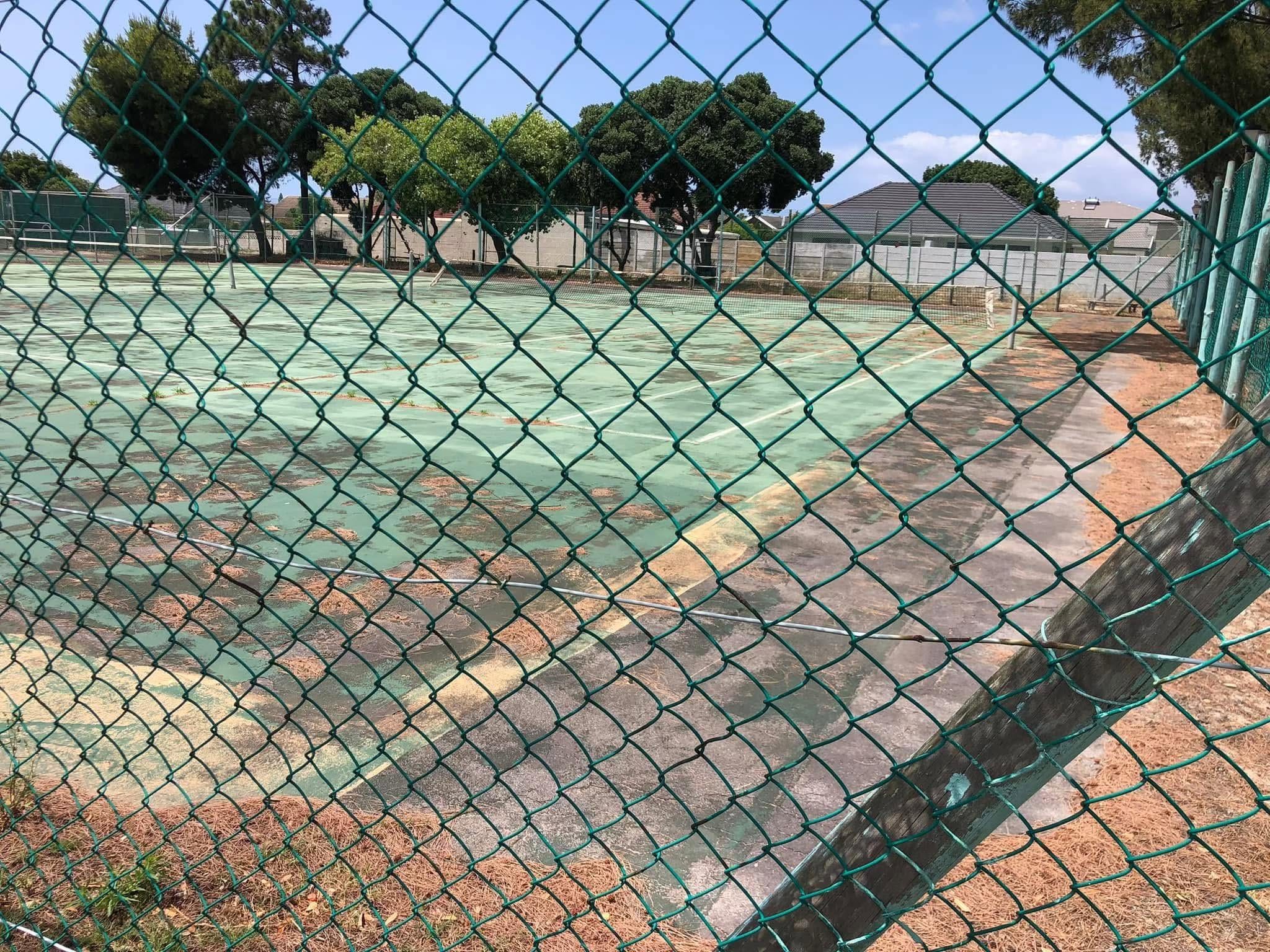
(image: Heathfield Tennis Club META Facebook page)
Fresh off the latest shenanigans from the Democratic Alliance (DA), with talk of municipal services essentially being outsourced, it should piss me off more than it does. But I keep coming back to what might seem like small issues, because sometimes the small things are a microcosm of how a city is run and, more importantly, who it is run for.
It also doesn’t help that the mayor is always on the Cape Flats doing the mayorly kak all mayors do: opening supermarkets, shaking hands at newly opened clinics, showing up for community events and generally being photographed doing mayor things.Lately, he has been playing dominoes. And then there is the street tennis.I am petty, so I cannot let this one go. I grew up watching Wimbledon during the school holidays. We would watch the matches and then run outside and stage our own little tournaments in the streets. Tennis, for me, is wrapped up in childhood nostalgia: watching the greats on television and then taking whatever space was available to us and turning it into our own version of Centre Court.
So seeing the mayor repeatedly playing street tennis on the Cape Flats is not lost on me. But okay. He is a public official. This stuff is probably on his agenda, brainstormed by his bevy of PR officials. And the DA, as always, will clamour for the coloured vote till kingdom come in ǁHui ǃGaeb. The bare minimum is often all that is required. Show up in people’s spaces, play some games, shake some hands, take a few photographs and gwa, campaign done.
Except here is the thing. The mayor plays tennis. Communities are fighting to keep somewhere to play it.
Two communities on the Cape Flats have been fighting tooth and nail to keep two tennis courts open, and they are sadly losing the battle.And this is where the street tennis photographs stop being cute. Because these courts are not simply pieces of municipal land with nets and cracked surfaces. They are some of the few outdoor spaces where people can spend time, exercise, meet other people and build community without having to spend money. The City of Cape Town, meanwhile, appears to be crickets. Launching manifestos. Paddling in potholes. Playing dums. While communities are sukkeling in a game of vriet kaart just to keep a recreational space open.
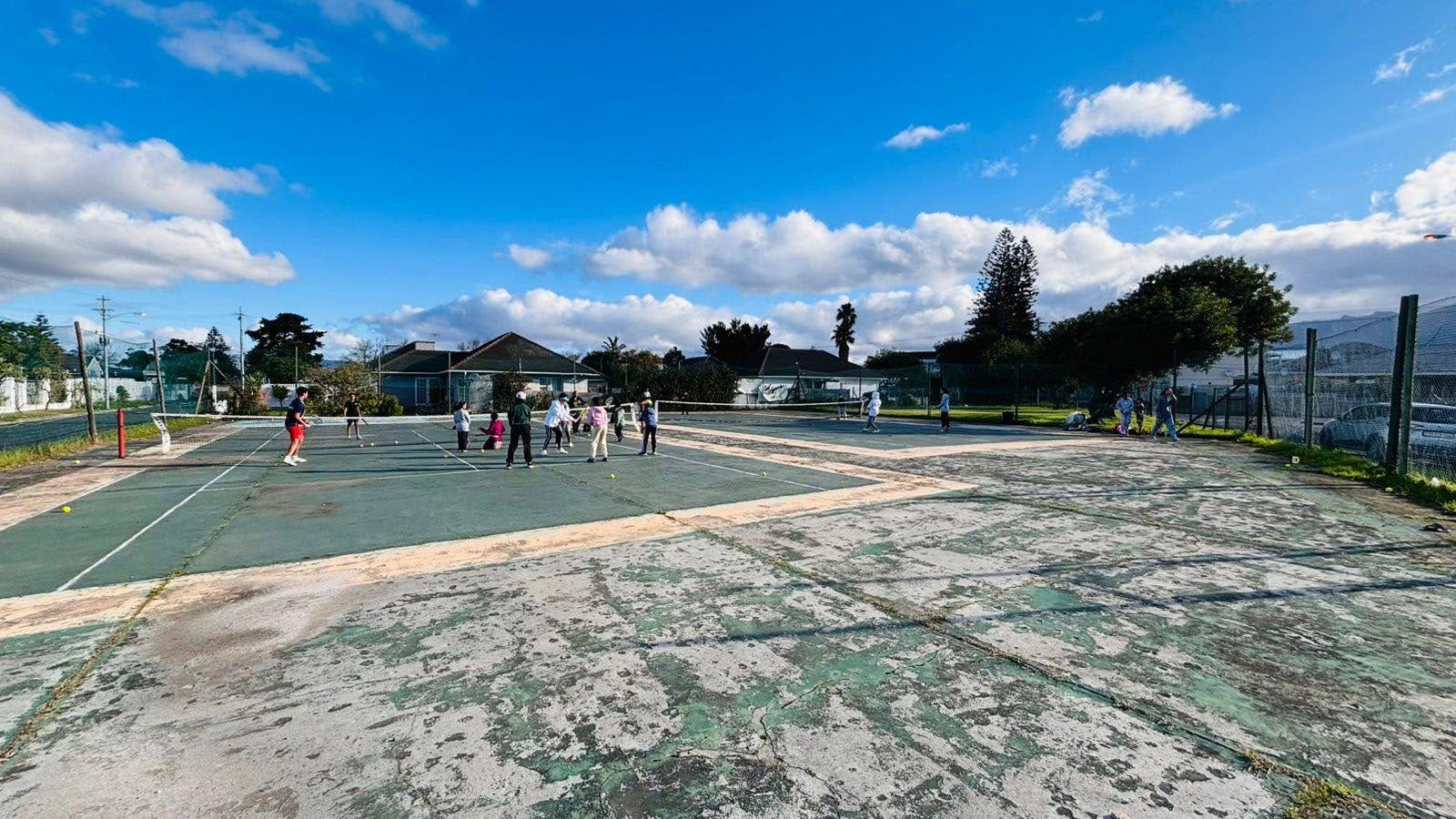
(image: Lansdowne Tennis Club META Facebook page)
Local Communities: 0, City of Cape Town: 15… Game, Set, Match?
I really didn’t think much of a post in a local community WhatsApp group at first.It was a link to a petition calling for support for the tennis courts in Heathfield and Lansdowne.I have always watched and loved tennis, but I never played or used the l local courts myself. To me, tennis was mostly nostalgic: school holidays, Wimbledon on television, and then running outside afterwards to stage our own tournaments.But I checked my apathy pretty quickly. Just because something does not affect us directly does not mean we cannot have empathy, or lend a hand where we can. And what I found was much bigger than two tennis courts.
Lansdowne: when a public sporting space becomes a lease problem
The Lansdowne Tennis Club is a third-generation community hub dating back to the 1960s. It has survived decades of change, and now its existence has become entangled in something that is bureaucratic at its heart, a public sporting space: a lease.
According to the City, the original lease with the Lansdowne Tennis Club was concluded in 1993 and terminated in 2018 after the club disbanded. No valid lease has existed since then and no rental payments were received, although the courts continued to be used by the local community for recreation and sport. The City says Recreation and Parks is now willing to assume responsibility for the facility as a sporting amenity, while the revived club has applied for a new lease. For now, the proposed disposal has been paused while that application is assessed.
And this is where I start asking questions.
Why does a community sports facility have to fight its way back into existence through a lease in the first place? To be clear, the City does have a system for this. Its own Sports Assets Management Policy says clubs cannot occupy a municipal sports asset without an occupancy agreement, which can take the form of a lease, management agreement or booking. So I am not arguing that there should be no accountability around who uses public land, who maintains it or how it is managed.
I am asking why the starting point so often seems to be the administration of the land as a property transaction, rather than the protection of the community function that land already serves?
Because the City’s own policy framework says that access to sport and recreation is important to building healthy, liveable and inclusive communities, and that the City has a role in providing accessible, affordable and safe recreational facilities, particularly in previously underserved areas.
The City’s own records also show that leasing municipal sporting facilities to community clubs is not unusual. In other parts of Cape Town, sports clubs have been granted leases over City land specifically for sporting and recreational purposes, sometimes at nominal tariff rentals, with conditions around maintenance and continued community sporting use. So why did Lansdowne get as far as a proposed disposal? That is the question I keep coming back to.
Because while the paperwork moves between Property Transactions and Recreation and Parks, there are actual people using these courts.
The club was revived in February 2025 under new leadership and, according to Athlone News, has become a gathering place for the community. Volunteers run free tennis sessions for children, and residents have rallied around the courts. More than 1 000 people had signed an online petition opposing the proposed disposal by the time the City announced that it would pause the process and assess the club’s lease application. The courts are also in poor condition. There are cracked surfaces, loose patches and uneven areas, and players have already been injured. Yet despite that neglect, the community is trying to breathe life back into the facility.
That, to me, is what makes me JAS.
The community is saying: we want this place. We will use it. We are willing to organise around it. We want our children here.
And the City’s response becomes a question of leases, property status, disposal processes and administrative responsibility. What does a city owe a community that has kept a public sporting space alive, even when the bureaucracy around it has not?
Sometimes it is that an old woman who has lived in the neighbourhood for 43 years can point to the courts and tell you that her children grew up there. Sometimes its value is simply that people have somewhere to go where nobody is asking them to buy something. And that is a kind of public value that does not always fit neatly into a property transaction.
Heathfield: another legacy under threat
Then there is Heathfield Tennis Club. For years, the club has been advocating for the repair and upgrading of the Chadwin Road courts, which have fallen into disrepair.
Again, the community has done the work of showing that the space matters.
The club has persisted. It has advocated. It has tried to keep the courts alive.And yet the City of Cape Town has not provided the necessary support to bring the courts back to the standard the community deserves.
The surrounding communities include Grassy Park, Lavender Hill, Steenberg, Retreat and Heathfield. These are communities where accessible recreational spaces matter.
And that is what keeps getting lost when we talk about municipal land as if it is simply an asset on a spreadsheet.A tennis court is not just a tennis court.
It is somewhere young people can spend an afternoon that does not require them to buy anything. It is somewhere people can simply exist.
WHAT GETS TO ME THE MOST IS THIS SHRINKAGE OF SPACES, WHERE YOU DON’T NEED MONEY TO EXIST IN, COMMUNE IN, BUILD FRIENDSHIPS AND COMMUNITY.
We are living in one of the most unequal cities in the world, in a country where millions of people are working but still struggling to make ends meet.
What happens when public space is increasingly treated as something that must justify itself financially? This is why I cannot bring myself to dismiss the fight over two tennis courts as a small issue. They are signs we keep ignoring.
If the City of Cape Town cannot find the political will or compassion to protect two relatively small community spaces when the communities themselves are saying, loudly and repeatedly, we need these, what does that tell us about how the City approaches the much bigger public goods that poorer communities depend on?
We can lay blame wherever we want. National government. Provincial government. Local government. But local government is where so much of daily life actually happens. It is where people encounter the state on the ground. It is where streets are maintained, parks are managed, public facilities are provided and communities interact directly with the institutions that are supposed to serve them. And it is why the City’s approach to public space matters.
This isn’t really about tennis
We are a nation of working poor, yet our local government acts with impunity, showing a lack of compassion and political will to keep these public, free spaces open in one of the most dangerously unequal cities in the world.
(ps. these are just two tennis courts I have read about, who knows what else is going on?). I am going to fix my language too here. These actually are not just two tennis courts. They are signs we keep ignoring, if the city of cape town and the DA at large cannot even be compassionate enough to save these two spaces, what of the bigger issues outside of recreational spaces? They clamour for support and post all the victories, then why are so many people starving, unhoused, unemployed, struggling to afford basics? Now we can lay blame anywhere, from national to provincial to local. But local is where change is better effected, care is better distributed because it is on the ground. Now they are basically threatening privatisation, and yes is is threat, and setting themselves up to earn government salaries yet outsourcing their responsibilities? They are essentially more dangerous than someone threatening you directly, because they are doing it through policy, by-laws and profiteering, all at the expense of the working poor.
It’s time to stand up for our communities. Support the efforts to save the Heathfield and Lansdowne tennis courts by signing petitions, attending community meetings, and raising awareness. Let’s ensure that our public spaces remain accessible for all, and where everyone can thrive without the barrier of cost. City of Cape Town being the city that works for a few.
ps. stop inviting that bra into your leisure spaces, he doesn’t care. If he did the courts would have been saved a long time ago, and not subject to laborious processes. Ya’ll are also one invite away from playing kennetjie with a man and his administration who only do things for the gram.
The wildest part is that the losing side is always the community. Like it is the one constant in cape town.